
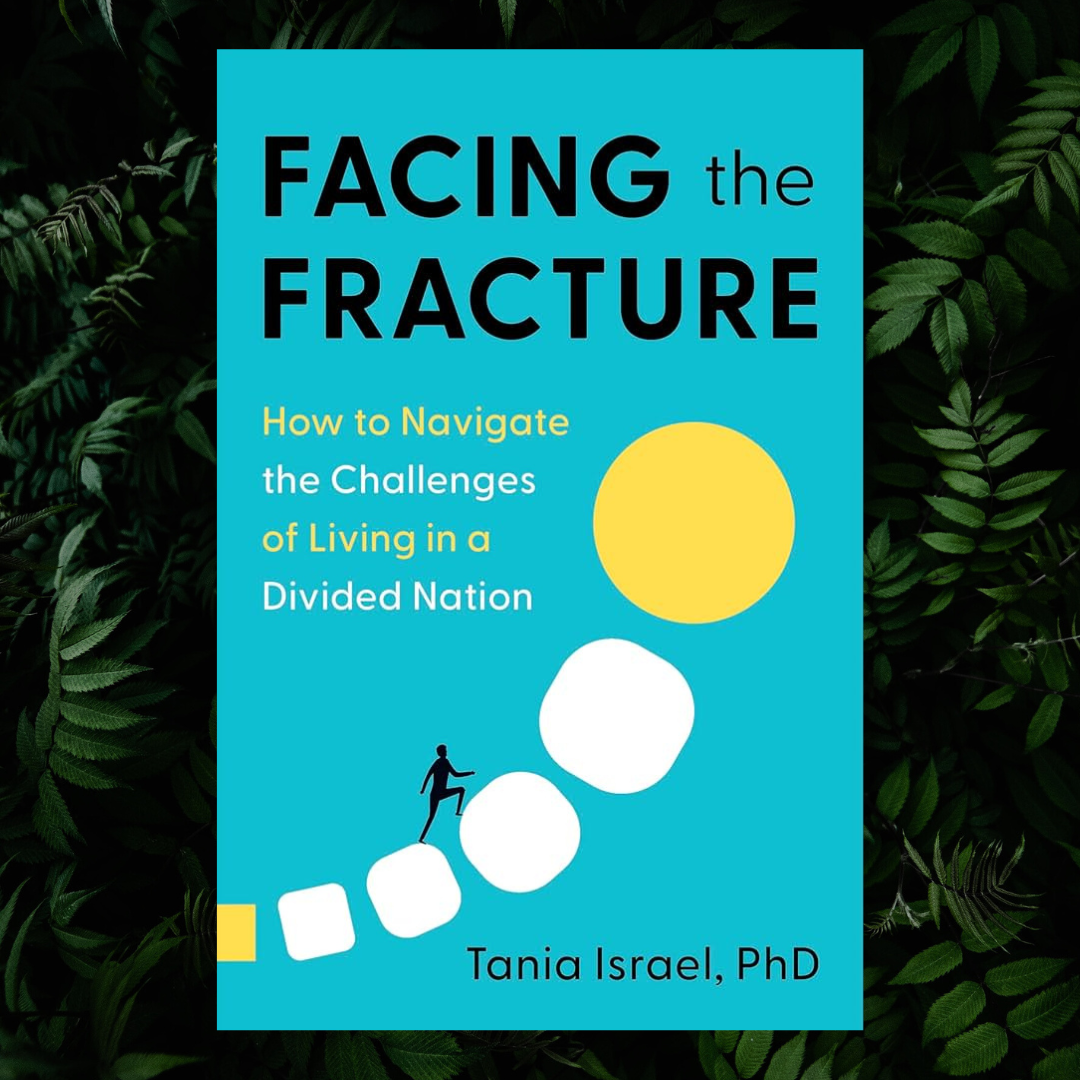
Facing the Fracture by Tania Israel, PhD (Book)
This Featured Resource is a just-in-time-for-the holidays edition! Both easy to read and scientifically anchored, Facing the Fracture presents a guide for building relationships with people you disagree with on important social and political issues. What’s more - it even includes “The Flowchart That Will Resolve All Political Conflict In Our Country.”
I heard Tania Israel speak at a psychology conference in October of this year (2025), and to be honest, just based on the title of the talk I wasn’t looking forward to it. I really didn’t want to listen to a high-minded argument for greater civility given all that the last 11 months has been about in our country. Admittedly, I consume an excessive amount of news - I scan the headlines on several news sites throughout the day, often have a political podcast playing, and typically will read or skim the articles, newsletters, blogposts, and political social media posts people send me. Like so many of us, my media algorithm is constantly fueling a fire of dysphoria in my soul. Our country’s partisan divides have been a constant worry, and, at a professional conference it was just the last thing I wanted to be thinking about. But I have to hand it to her, she snagged me at the top of her talk with a strong hook: “We are not as polarized as we think we are.”
I was curious…and skeptical.
She next asked if we believe in science and would be open to research spanning 40+ years that supports her claim, which we all did/were. She then spent the next half hour reviewing the research and proving her case that we are not as divided as we feel. She also provided a model for building capacity to engage in constructive conversations and engage civilly across deep differences. I left that session feeling more encouraged than I’d felt in over a year. This book reads as the expansion of that talk. I’m excited to share it with clients, so here’s a basic overview of it.
It is broken into three sections. The first section looks at what’s gotten us here: the psychological basis for polarization and how news and social media consumption amplify this instinct. The first section also discusses three biases we bring to the media we consume and conversations we have (confirmation bias, motivational attribution asymmetry, and naïve realism at the end of section).
The second section of the book is about building individual capacity for engaging others. This section is loaded with practical tips for increasing self-awareness, developing perspective taking skills and intellectual humility, and compassion.
The third and final section offers guidance on how to participate in these conversations. Instead of providing a framework for winning a debate, this section emphasizes the importance of learning to engage across differences. This strengthens our connections with the people we disagree with and provides the logical underpinnings for a healthy democracy. The book ends by highlighting specific organizations involved in the work of fostering civil dialogue across contentious issues.
There’s much to like about this book. It is timely - in fact many of her examples come from the last three years of our nation’s history. Her examples of vaccine hesitancy and electoral college issues feel relevant and fresh. The book is also very practical. It can be used as a reference manual when you are getting ready to head to Thanksgiving with extended family or when you finally feel ready to get involved in a bridge building organization. Finally, it is a hopeful book. It leaves you feeling like there may be a path forward. Despite all of the legitimate reasons for despair in our society and world, there are reasons to believe in democracy and meaningful ways to participate in it on individual, local, and national levels.
“Dialogue is an empowering practice that can help to correct our distorted perceptions, repair our ruptured relationships, and help us connect with the humanity and complexity in ourselves and others.” (p. 183)
“So, what’s the payoff to viewing our adversaries with greater accuracy? A shift in perspective can turn down the dial on stress about political conflict. Feeling less embattled, we are more likely to maintain relationships with loved ones who have opposing views. Optimism will encourage us to stay engaged across political differences. In short, challenging our biases can sustain our most cherished assets: health, human connection, and democracy.” p. 85
If you don’t have time to read the book, consider watching her TED Talk on “What Halibut Fajitas Taught me About Bridging the Political Divide.” (But don’t listen to it if you don’t like hearing about food poisoning.) You’ll get a great overview of how these biases show up in our conversations with people with whom we disagree.
Important Links:
Please know these summaries are not written with the assistance of generative AI. The only automated assistance comes through the spell check and grammar check features of Google Docs.
